Word Journey: Word Puzzle
- 4.6
- Rating
- 50.00K
- Installs
- Free
- Price
 Analysis by App-foxy
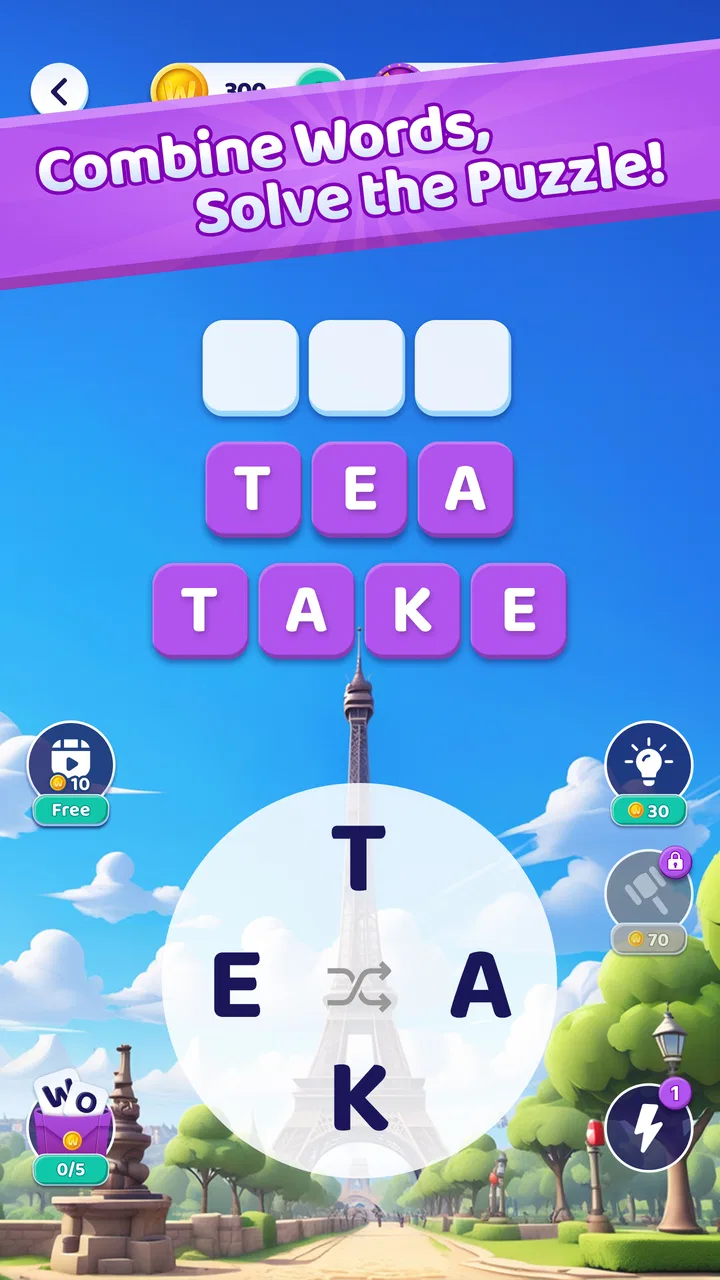
I spent time with Word Journey: Word Puzzle as a quiet, letter-focused game rather than a fast arcade challenge, and that distinction matters. Its central appeal is simple: connect letters to complete crossword-style answers while moving through a travel-themed progression. The idea sounds familiar, but the way it turns a few spare minutes into a small mental routine is what makes it worth considering.
This is a free word game from Lumica Games, listed for Everyone and available for devices running Android 7.1 or newer. It has reached over 50 thousand installs and holds a 4.6 average from roughly 448 ratings, which suggests that its relaxed format is connecting with a useful audience. I found it most enjoyable when I wanted something gentle enough for a break but still active enough to keep my attention.
Why the travel-style crossword format works
The defining capability here is the combination of letter connection and crossword solving. Instead of presenting a large, intimidating grid, the game gives me a compact word task: look at the available letters, join them in a possible order, and see how they fit into the puzzle. That creates a pleasant middle ground between a traditional crossword and a simple anagram game.
You May Also Like

 Blood Strike: 2.5 Anniversary
Blood Strike’s Loadouts Turn Every Drop Into a Tactical Gamble
A close look at Blood Strike’s custom loadouts: how fast access to signature weapons reshapes its battle royale rhythm, rewards preparation, and narrows the gap between fights.

 Pandora - Music & Podcasts
Pandora’s Music Is Easy to Start, but Harder to Recover
Pandora’s strength is its low-effort path from a seed to a station. Its weak spot is how much confidence it asks you to place in connection, setup, and quiet recovery.

 8 Ball Pool
 Is Built on Rivalries, Rematches, and Routine
A close look at the rivalries, rematches, shared routines, and unanswered safety questions that turn a quick pool match into a persistent mobile community.

 Samsung Music
’s Quiet Strength Is Playing What You Already Own
Its reach comes less from spectacle than from dependable access to a personal library. That simplicity is both the app’s strongest retention engine and its ceiling.

 AccuWeather: Weather Radar
AccuWeather Review: A Quick, Clear Forecast for Everyday Decisions
For everyday plans, the best forecast is the one you can understand quickly. AccuWeather makes rain timing, radar, and local conditions easy to act on, with a few trade-offs.

 Hill Climb Racing
Why Hill Climb Racing Still Turns Crashes Into One More Run
A tiny car, a bumpy hill and one more upgrade: Hill Climb Racing keeps resurfacing because its simple chaos makes every near-miss feel personal.
More From Our News Desk
View All News


The travel framing gives the individual puzzles a sense of movement. I am not only clearing unrelated word boards; I am progressing through a broader journey. Even when the actual action remains focused on letters, that context gives each solved group a little more purpose. It is a small design choice, but it helps prevent the game from feeling like an endless stack of disconnected exercises.
The strongest part of Word Journey is its low-pressure rhythm. I can start a puzzle without preparing for a long session, make progress at my own pace, and stop after a few answers. That makes it particularly suitable for waiting rooms, short commutes, coffee breaks, or the few minutes before bed when I want something more engaging than scrolling but less demanding than a full game.
It is also a good fit for players who enjoy vocabulary games without needing a dictionary-sized challenge. The crossword structure gives me a reason to think about word relationships, while the letter connections keep the interaction direct. I do not have to manage a complicated interface or learn a large set of rules before getting into the puzzle.
How the letter connection feels in practice
In use, the basic loop is easy to understand. I examine the letters presented on the board, try a possible connection, and watch the answer settle into the crossword layout when it belongs there. The pleasure comes from the small moment of recognition: a group of letters that looked ordinary suddenly becomes the missing answer I needed.
That interaction also creates a useful difference between knowing a word and spotting it. Sometimes I understand the likely answer but fail to see it in the available letters. At other times, I notice a short word first and use it to open up the surrounding puzzle. This makes the game feel more active than simply reading clues and typing responses.
The format rewards a practical solving habit: start with the obvious short answers, then use the remaining letters to narrow down the longer possibilities. I found that approach more reliable than trying to force a clever word immediately. When I became stuck, I would mentally rearrange the unused letters, look for common endings, and return to the crossword pattern rather than repeatedly making random attempts.
That is one of the less obvious strengths of the design. The game quietly encourages pattern recognition. I began paying attention to familiar combinations, plural endings, and the way an already completed section constrained the next answer. It is not a formal vocabulary course, but it does make me more attentive to how words are built.
Another useful habit is to treat the board as a network rather than a sequence. A word that seems unimportant can reveal the shape of another answer once it fills its spaces. If I only chase the longest visible possibility, I can miss the smaller answer that provides the real breakthrough. This is where the crossword element adds value beyond a basic letter scramble.
A realistic everyday session
My most natural use case was a short evening pause. After finishing other tasks, I could open the game, solve part of a board, and put the phone down without feeling that I had committed to a long campaign. The travel progression gave the session a sense of continuity, while the individual puzzles remained small enough to fit around real life.
The same pattern should work well during a commute, provided the player is not trying to use the phone while moving. It is easy to imagine solving a few answers while waiting for an appointment, then returning later with the puzzle still serving as a small unfinished thought. For people who like casual games that can be played in fragments, this is more convenient than a word title that expects a complete timed round.
I also think it can work as a shared activity. One person may notice a word pattern while another spots the answer hidden in the letters. Because the rules are immediately understandable, it does not take much explanation to let someone else join in. That said, the experience is still primarily designed for individual concentration rather than lively group competition.
Where it differs from familiar word games
Compared with a traditional crossword app, this game feels lighter and more guided. A conventional crossword often depends heavily on clue interpretation, general knowledge, and a willingness to sit with a large grid. Here, the letters themselves provide more assistance, so the challenge is less about solving an abstract clue and more about recognizing viable combinations.
Compared with a pure anagram game, the crossword layout gives my answers a clearer destination. I am not merely checking whether I can form a word; I am fitting that word into a structure. This makes mistakes more informative because the board tells me whether an answer belongs in the current puzzle.
It is also less suited to players who want competitive pressure than games built around timers, daily rankings, or head-to-head matches. The attraction here is the journey and the calm solving loop, not the adrenaline of beating another player. If my main goal were speed, competition, or a demanding clue database, I would look elsewhere.
The tradeoffs behind the relaxed design
The gentle pace is both the game’s main advantage and its clearest limitation. Players who prefer constant novelty may find the repeated letter-and-crossword cycle too restrained. The travel theme adds atmosphere and progression, but it does not transform the underlying activity into a different genre. After several sessions, the appeal depends on whether I genuinely enjoy word discovery.
Difficulty can also feel personal. Someone comfortable with English word patterns may move quickly through familiar combinations, while another player may find an apparently simple board unexpectedly stubborn. That unevenness is normal for vocabulary games, but it means the experience will not feel equally challenging for every player.
The free entry point is helpful because I can try the core experience without paying upfront. However, the game includes optional in-app purchases ranging from $1.49 to $49.99 per item. I would approach those purchases carefully and decide first whether the basic solving loop has earned a place in my routine. A free word game is easiest to recommend when players treat paid extras as optional rather than necessary for enjoyment.
The current version is 1.6.5, and the game was released on June 23, 2025. Those details are useful when checking compatibility or deciding whether the title is recent enough for a new installation. I would still make sure the device meets the minimum Android requirement before downloading, especially on an older phone or tablet.
Because the age classification is Everyone, the game is positioned as a broadly accessible word puzzle rather than an adult-focused title. That does not guarantee that every player will enjoy its vocabulary level, but it does make the format easier to consider for families or mixed-age households looking for a calm puzzle activity.
Small solving techniques that make a difference
My first practical tip is not to spend too long defending an initial guess. If a word looks plausible but does not fit the available spaces, I move on and use the remaining letters as evidence. The crossword layout is more useful when I let it correct me instead of trying to force a preferred answer.
My second tip is to scan for short connecting words before hunting for impressive ones. Short answers often reduce the number of possible arrangements and reveal what the longer answer must look like. This is especially useful when several letters can form multiple familiar fragments.
My third tip is to pause after a failed attempt rather than immediately repeating the same pattern. Looking away for a few seconds changes how I see the letters. When I return, an answer that seemed invisible can become obvious because I am no longer locked into the first arrangement I imagined.
A fourth useful approach is to play in deliberate mini-sessions. The game’s relaxed structure makes it tempting to continue simply because the next answer is close, but stopping after a natural puzzle boundary keeps the experience refreshing. It also makes the title a better fit for people who want a controlled break instead of another game that absorbs an entire evening.
Who benefits most from this particular game
I would recommend it first to casual word-game players who like visible progress and a calm pace. It is especially appealing if I enjoy anagram-style thinking but want more structure than a loose collection of letter mixes. The travel progression gives the puzzles a modest sense of purpose without requiring a deep story or complicated character system.
It may also suit people returning to word games after a long break. The interaction is approachable, the boards are easier to understand than a large traditional crossword, and the player can build confidence by solving the most obvious combinations first. Someone looking for a quiet mental warm-up may appreciate that balance.
On the other hand, I would skip it if I need robust competitive features, highly technical vocabulary, or a strict timed challenge. It is not the right choice for a player who measures enjoyment by leaderboards or rapid score improvement. I would also choose a more clue-heavy crossword app if interpreting nuanced clues is the part of word gaming I enjoy most.
Families should consider the individual player’s reading ability and vocabulary rather than relying only on the Everyone label. The game is accessible in presentation, but word puzzles can still vary greatly in difficulty from one person to another. For shared play, it works best when players are comfortable offering suggestions without turning every board into a contest.
My final recommendation
After using it as a short-session puzzle game, I see Word Journey: Word Puzzle as a dependable choice for relaxed letter solving. Its best quality is not a dramatic feature list; it is the way the connected-letter mechanic gives each crossword answer a clear, satisfying purpose. The travel framing then turns those small victories into a continuous route rather than isolated exercises.
I like that it can occupy five spare minutes without demanding a full commitment, while still giving me enough structure to think carefully. I also appreciate that the game rewards methodical observation more than frantic tapping. The limitations are real: the core loop may feel repetitive to competitive players, and optional purchases mean I would keep an eye on spending. Still, those concerns do not undermine the basic free experience.
For me, the deciding question is simple: do I want a calm word puzzle that I can pick up and leave easily? If the answer is yes, Lumica Games has made a pleasant option. If I want intense competition or advanced crossword clues, I would choose another category of word game. For everyone in between, this is a friendly, focused way to turn a few idle moments into a small journey of word discovery.
FAQs for Word Journey: Word Puzzle
01What is Word Journey: Word Puzzle, and how is the gameplay structured?
Word Journey: Word Puzzle is a casual word game built around solving letter-based puzzles while progressing through a journey of themed levels. Players typically swipe or tap letters to form words, complete crossword-style layouts, and unlock new stages. The game is easy to understand at first, but later puzzles introduce longer words, less obvious combinations, and increasingly challenging objectives.
02Is Word Journey: Word Puzzle free to download and play?
Word Journey: Word Puzzle can generally be downloaded and played without an initial purchase, making it accessible to casual players. However, like many free mobile puzzle games, it may include optional in-app purchases for coins, hints, boosters, or other conveniences. Some versions may also display advertisements, so users should review the store listing and purchase settings before downloading or allowing children to play.
03Can Word Journey: Word Puzzle be played without an internet connection?
Some parts of Word Journey: Word Puzzle may remain available offline, especially previously loaded or standard puzzle levels. Nevertheless, an internet connection can be required for advertisements, synchronization, updates, rewards, events, or in-app purchases. Offline availability may also vary between Android and iOS versions, so players who need a fully offline experience should test the game after installation rather than assume every feature works without connectivity.
04Is Word Journey: Word Puzzle suitable for children and beginners?
The game is generally suitable for players who enjoy vocabulary challenges, including beginners and older children who can read the language used in the app. Early levels usually provide a gentle introduction, while hints can help when a puzzle becomes difficult. Parents should still check advertising, in-app purchase, and privacy settings, particularly if the game is installed on a child’s device.
05What should I know about hints, difficulty, and progress in Word Journey: Word Puzzle?
Word Journey: Word Puzzle is designed to become progressively more demanding, so players should expect some puzzles to require experimentation or the use of hints. Hints and bonus tools may be limited or connected to an in-game currency, depending on the version. Progress may be stored locally or synchronized through the platform, meaning users should check account and backup options before changing devices or reinstalling the app.
Pros
- Relaxing gameplay suitable for short or extended sessions.
- Helpful hints make difficult levels less frustrating.
- Progression system encourages regular daily play.
- Clean interface is easy for new players to understand.
- Works well for improving vocabulary and spelling skills.
Cons
- Some levels may feel repetitive after extended play.
- Hints and extra features may require in-app purchases.
- Difficulty can vary noticeably between consecutive puzzles.
- Ads may interrupt the experience for free users.
- Requires patience when searching for less familiar words.

Word Journey: Word Puzzle
Gallery